




 ADDED TO CART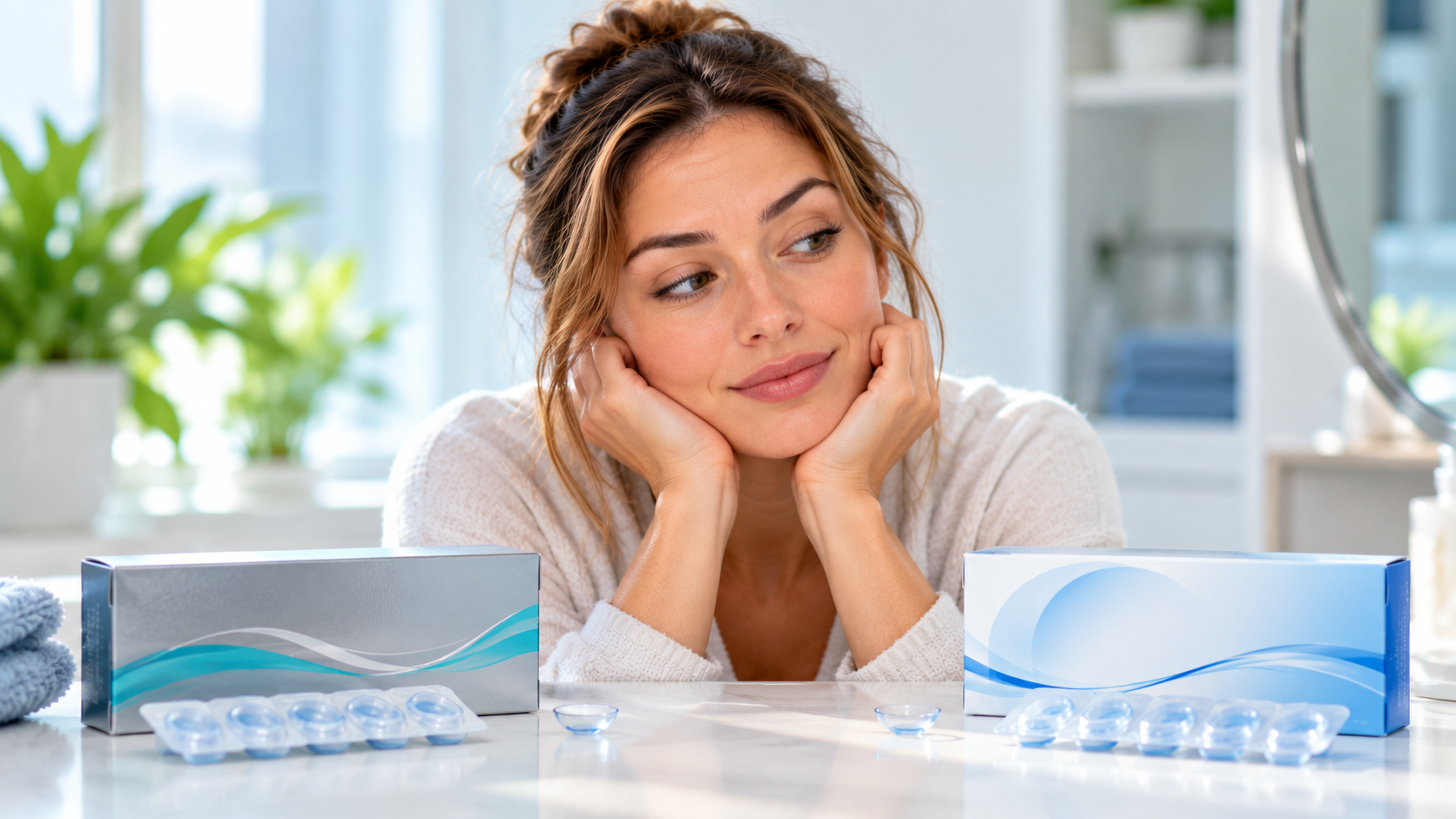
Same brand, same trusted Acuvue name on the box. Even so, these two lenses ask you to live with contacts in very different ways. Acuvue Oasys is a bi-weekly lens that you clean and reuse for 2 weeks. 1-Day Acuvue Moist is a daily disposable you open fresh each morning and throw away at night. So the real question is not which lens is better, but which rhythm fits your eyes, your routine and how often you actually reach for contacts.
At ContactsDirect we carry the full Acuvue range, so we have no reason to steer you either way. Free shipping comes with every order. You can also put insurance and FSA/HSA dollars toward whichever you choose. Here is how the two compare on the things that genuinely change your day.
The real split: 2 weeks vs 1 day
The biggest gap between these lenses is the replacement schedule, and it shapes everything else. Oasys is a bi-weekly lens, so you wear the same pair for up to 2 weeks. Each night the pair goes into a case of fresh solution. Moist is a daily disposable, which means a new, sterile lens every morning, with no case and no solution to carry. That single difference drives most of what follows, from your evening routine to the way a year's supply of lenses arrives at your door.
It also shapes how you buy. Oasys comes as a 12-pack for 6 months, or a 24-pack for a full 12-month annual supply. Moist comes as a 30-pack for roughly a month, or a 90-pack that covers 3 months of full-time wear.
|
Acuvue Oasys |
1-Day Acuvue Moist |
|
|
Replacement schedule |
Bi-weekly (every 2 weeks) |
Daily (new lens each day) |
|
Reuse |
Yes — clean and store overnight |
No — discard every night |
|
Daily upkeep |
Case and solution |
None |
|
Core comfort tech |
HYDRACLEAR Plus |
LACREON |
|
UV filtering |
UVA and UVB |
UVA and UVB |
|
Largest pack |
24-pack (12-month supply) |
90-pack (3-month supply) |
|
Also comes in |
Toric, multifocal |
Toric, multifocal |
Comfort and moisture: different tech, same goal
When you spend all day in lenses, comfort is the spec that really counts. Acuvue builds it into these two lenses in different ways. Oasys uses HYDRACLEAR Plus Technology, a steady cushion of moisture across the lens. That cushion holds up in dry offices, on long commutes and through hours at a screen. Oasys is also made for high oxygen transmissibility, so more oxygen reaches the cornea, the clear front of your eye, and your eyes stay whiter and feel fresher across the full 2-week cycle. Acuvue calls it the world's most prescribed contact lens, and that comfort record is why.
Moist works the other way around. LACREON Technology locks a moisture-rich wetting agent into the lens material itself. The hydration is there the moment you put the lens in, and it lasts until you take it out. The bigger advantage is simpler than any ingredient. Because you start each day on a brand-new lens, nothing builds up on the surface to dry against your eye by mid-afternoon. That daily reset can matter most for sensitive or allergy-prone eyes, and it is why some afternoon-dry wearers move to dailies and never look back.
Both lenses handle a long day well, so the gap really shows only at the edges. Oasys leans on its moisture cushion, and Moist leans on newness. The right answer depends on the eyes you actually have.
Upkeep, hygiene and wearing them safely
That daily reset does come at a cost you skip with dailies: a small routine. Pick Oasys and your evening gains a few steps. You rinse the lenses, store them in fresh solution and start the next day with a clean case. Skip those steps, or top up old solution instead of replacing it, and you invite trouble. The CDC links most contact lens-related eye infections to wear-and-care habits, not to any particular lens. [1] Moist sidesteps the routine, since a used daily lens goes in the trash, not back in a case.
One rule holds for both lenses. You wear them exactly as your optometrist prescribes. Oasys can be worn for up to 6 nights of continuous wear. But that only applies when your eye care professional has approved it, because the option rests on the lens being made for high oxygen flow. A daily lens is never meant to be slept in or worn a second day. Both lenses also filter UVA and UVB rays, which is a genuine plus. Even so, a contact lens cannot cover the whole eye, so it is no substitute for a good pair of UV-blocking sunglasses. [2]
Which Acuvue lens fits your day?
If you find yourself in lenses only now and then, the choice tips fast toward Moist. Think a weekend away, a workout or a night out. There is nothing to maintain between wears, and no half-used bottle of solution dries out in a drawer. First-time wearers often start here too, because a fresh daily lens is the most forgiving way to learn handling and hygiene. Plenty of full-time wearers with sensitive eyes stay with dailies for the same reason: they get a clean lens every single morning.
Oasys earns its place for the committed all-day wearer who is happy with a short care routine. In return, you reorder fewer boxes across the year, and a single 24-pack covers a full 12 months. A bi-weekly pair also spreads its value over 2 weeks of wear, not one day. So the running rhythm often sits easier on the budget than a daily habit does.
Your prescription need not decide this for you. Both lenses reach well past basic nearsightedness and farsightedness. Say you have astigmatism, an unevenly curved cornea that blurs vision at every distance. Acuvue Oasys for Astigmatism uses a BLINK STABILIZED design, which harnesses your blink to stop the lens rotating. 1-Day Acuvue Moist for Astigmatism offers the same stabilized design in a daily. Or say you have presbyopia, the age-related loss of near focus. Acuvue Oasys Multifocal uses a Pupil Optimized Design. 1-Day Acuvue Moist Multifocal blends near, intermediate and far vision with SEAMLESS TRANSITIONS Design.
Still weighing it up? Browse both lines side by side on our Acuvue hub. Set the full bi-weekly range against our daily disposables. Remember that insurance and FSA/HSA dollars come off the total at checkout, and shipping is always free. If astigmatism is in the mix, our toric lens hub narrows the field further.
Sources
[1] Centers for Disease Control and Prevention — most contact lens-related eye infections are linked to wear-and-care habits such as sleeping in lenses and poor case hygiene, not to the lens brand.
[2] American Academy of Ophthalmology — UV-filtering contact lenses do not cover the entire eye and are not a substitute for UV-blocking sunglasses.

